The Entrepreneur’s Guide to Smarter Facility Investment Decisions
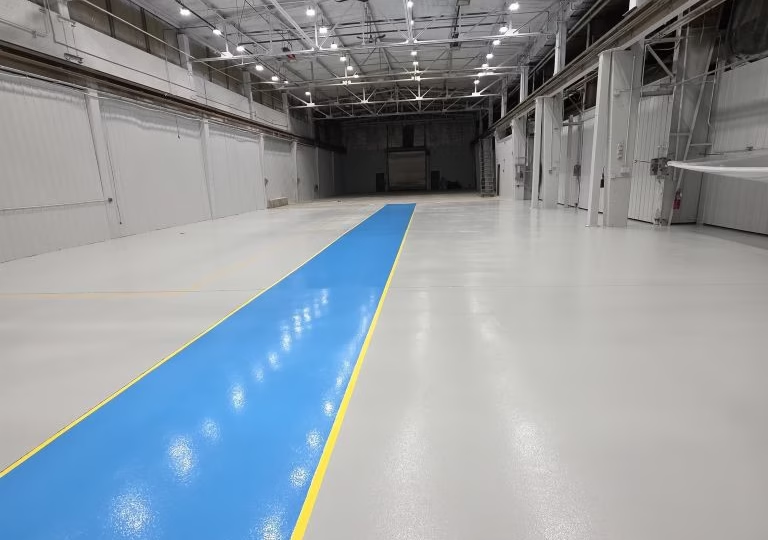
Entrepreneurs are wired to focus on product, team, and market. These are, without question, the most important pillars of any business. But seasoned operators know that the facility environment is not just a backdrop for those activities. It is an active part of the operational equation. Industrial epoxy flooring is one of those facility decisions that sits quietly in the background but influences everything from daily productivity to insurance premiums. For entrepreneurs moving into owned or long-term leased industrial spaces, understanding the flooring decision early can prevent costly mistakes and unlock operational advantages that competitors will struggle to match.
Why First-Time Facility Owners Get This Wrong
Many entrepreneurs setting up their first industrial facility treat flooring as a line item to minimize rather than an investment to optimize. They accept the bare concrete the landlord provides, apply a basic seal coat, and move on to bigger concerns. That decision often costs more than the savings it creates. Within a few years, dusting concrete contaminates product or inventory. Surface deterioration creates tripping hazards. Forklift maintenance costs rise because rough surfaces accelerate component wear. What seemed like a prudent budget decision turns into an ongoing operational drag that was entirely avoidable.
How to Evaluate Flooring Providers Like a Business Analyst
Choosing the right flooring contractor is as important as choosing the right product. Entrepreneurs should approach this decision with the same rigor they apply to vendor selection in any other area. Ask for case studies from similar facility types. Request references from clients who have had installations in place for three or more years. Understand the warranty terms in detail, including what is and is not covered and what actions void coverage. Confirm that surface preparation methodology, particularly concrete grinding and moisture vapor testing, is included in the scope of work. Cheap installation that skips proper prep is the most common cause of premature failure in epoxy flooring systems.
Stories from the Floor: What Operators Report
Talk to any operations manager who has overseen an industrial epoxy flooring installation and you will consistently hear the same themes. The floor looks better than expected and holds up longer than anticipated. Cleaning time drops noticeably. Visitors and auditors comment positively on the facility condition. And perhaps most meaningfully, floor-related maintenance issues essentially disappear from the operations conversation. These firsthand accounts are valuable because they reflect real-world performance under the kind of conditions that no spec sheet can fully anticipate.
Planning for Growth When Making Flooring Decisions
One hallmark of strategic business thinking is making decisions that account for where the business will be, not just where it is today. An entrepreneur opening a 15,000 square foot facility today may be operating 50,000 square feet in five years. Choosing an industrial epoxy flooring system designed for heavy industrial use from the start, rather than the minimum needed for current operations, avoids the costly and disruptive process of re-flooring a scaled-up facility mid-growth. It is the kind of forward-looking decision that separates operators who get ahead of problems from those who are always reacting to them.
Conclusion
Smart entrepreneurs know that every operational asset should be evaluated on the basis of long-term value, not short-term cost. Industrial epoxy flooring passes that test with room to spare. It protects your people, your equipment, and your investment in the physical space. For any entrepreneur serious about building an efficient, scalable operation, it is a decision worth making deliberately and making well.